Twenty Years After Toledo–MUO, When Is a Merger Done?
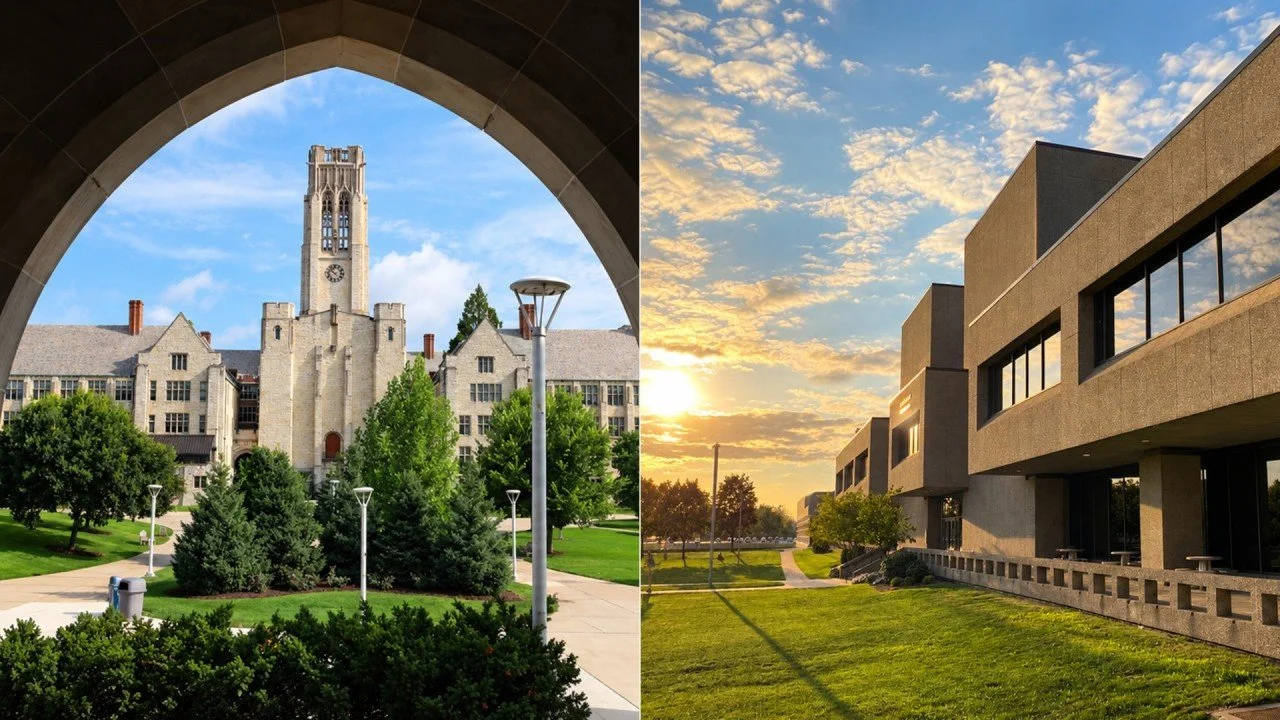
University Hall on UT’s Main Campus (left) and the Health Education Building on its Health Science Campus (right).
Brian Weinblatt, Ph.D., CFRE
Founder and Principal, HCS Strategy
The difference between completing a transaction and realizing its value.
Twenty years ago, I watched my alma mater become something new. I was working in alumni relations at The University of Toledo (UT) and pursuing my doctorate in higher education when UT and the Medical University of Ohio (MUO) announced their merger. I was fascinated by what the combination could create, and astonished by how far its leaders had brought it before most of us knew it was happening. That curiosity became my dissertation.
My understanding of mergers at the time was shaped principally by Toledo and the other institutions I studied. Today, I advise institutional leaders navigating these decisions themselves. I have seen promising combinations advance, opportunities unravel, and difficult choices made well and poorly. That experience has changed the questions I bring to Toledo’s merger. It has not changed my affection for the university.
I felt then that the merger was the best thing ever to happen to The University of Toledo. I still do. But affection is not the same as an obligation to look away. Twenty years later, its achievements and unrealized possibilities bring me to a question that matters wherever institutions contemplate combining: When is a merger actually done?
The promise of the combination
The idea of combining these institutions was older than I initially understood. During doctoral coursework, I visited UT’s Ward M. Canaday Center for Special Collections, home to the university archives in Carlson Library. There I found the papers of William S. Carlson, UT’s president from 1958 to 1972, and a 1961 report by William R. Willard, then dean of the University of Kentucky’s medical school. Willard wanted UT to strengthen its academic foundations, but also recommended planning for a medical center on its campus. The state established a separate medical school in 1964. ¹
When UT and MUO finally merged on July 1, 2006, I heard many others describe it as correcting a forty-year-old mistake. The combination also illustrated what James Martin and James E. Samels described as a mutual-growth merger: institutions with complementary strengths expanding what they could accomplish together. ²
One conversation from my dissertation fieldwork has stayed with me. Dan Johnson, UT’s president before the merger, told me he believed he was well qualified to lead the combined university and would have enjoyed doing so. According to Johnson, MUO President Lloyd Jacobs believed the merger could proceed only with him as chief executive. Johnson agreed to step aside.
“We were all stewards for a very brief period of time,” he told me. “This merger will go on for decades, hopefully longer.” ³
Johnson understood an obligation that extends beyond the negotiation of the transaction. Integration should have an endpoint. Stewardship should not. The merger’s purpose should continue to shape budgets, programs, and student opportunities long after its original leaders leave.
The Toledo experience helped me formulate three questions leaders should be prepared to answer by the time a merger becomes public:
Should these institutions merge—and what will they become capable of doing together?
What name and identity will the combined institution carry—and what will that choice mean for each institution’s constituents?
Who will lead the combined institution?
Toledo’s leaders had settled their central proposal: combine the institutions, retain The University of Toledo name, and have Jacobs lead. Public discussion, faculty participation, board action, and legislative approval proceeded from something concrete. ² ³
The change was visible almost immediately. New signage, logos, and colors made the former MUO unmistakably the University of Toledo Health Science Campus. On the main campus, we touted our gain of a medical school. On the health science campus, there was enthusiasm about gaining a football team. I took that visible integration as evidence that the merger was taking hold. A shared identity mattered. It was a foundation for the work ahead.
The combined university had medicine alongside engineering, pharmacy, law, business, the sciences, and the arts. We proudly described it as Ohio’s third-largest public university by operating budget. A hospital and clinical enterprise contribute substantially to that distinction. Students still have to choose the university. ²
An October 2006 presidential discussion draft envisioned 20,000 undergraduates and stronger connections to professional schools. It was an aspiration, but a revealing one: using the combined institution’s breadth to drive growth was part of the early thinking. Twenty years later, UT enrolls 10,566 undergraduates. ⁴ ⁵
Twenty years of gains and unfinished work
Not every subsequent achievement belongs in the merger’s credit column, and not every setback can fairly be blamed on it.
UT has achieved much. It earned Carnegie R1 status in 2025, recognizing very high research activity, and reported $72.2 million in competitive external research awards in fiscal 2024, its second-highest annual total. Research spans medical discovery, solar energy, water quality, and astronomy. Those achievements reflect years of faculty work, investment, and partnerships throughout the university. ⁶
The combination created opportunities worth celebrating. Bioengineering student Shereen Yassine was attracted by UT’s undergraduate research opportunities. After her first year, a funded summer program connected her with medical school researchers. She published, presented her work, and earned admission to UT’s medical school through its BACC2MD pathway. That is the merger’s promise made tangible. ⁷
UT also funds interdisciplinary research initiation awards, and its new Northwest Ohio Cancer Research Institute brings together fields including engineering, medicine, and pharmacy. These are concrete expressions of the combined institution’s strengths. The unfinished work is to make such connections an ordinary, visible part of the experiences of more students and faculty members. ⁷
In July 2024, UT introduced “The Power To Do,” describing it as the first common marketing framework for its academic and healthcare operations since the merger. Eighteen years after the campus rebranding I remembered, the university was still developing a shared explanation of its full capabilities. Its enrollment plan, completed that year, also made stronger undergraduate-to-graduate pathways an explicit priority. ⁸
A 2024 Faculty Senate committee criticized insufficient local recruitment engagement, slow implementation, unstable leadership, and offices working in silos. Its findings concern the university’s ability to execute, precisely what determines whether combined capabilities become advantages that students understand and use. A medical school becomes an advantage for undergraduates through pathways, mentoring, research, and appropriate clinical exposure. The organizational chart cannot do that work. ⁹
Leadership succession is another test. Johnson identified the recruitment of Jacobs’s eventual successor as a milestone: the first opportunity to recruit a president for the institution the merger had created. Every presidential search should reflect the combined institution’s expanded academic and clinical responsibilities. ³
I saw elements of that opportunity in Sharon Gaber’s presidency. Her trustees’ 2019 review credited her administration with meeting its graduation-rate target three years early, increasing retention and research awards, and exceeding fundraising goals. I wished she had stayed longer. ¹⁰
She left for UNC Charlotte in 2020, amid the pandemic’s extraordinary disruption. UT experienced five presidential handoffs between Jacobs’s departure in 2014 and James Holloway’s arrival in 2025. A board cannot make durable progress by relying on one president to stay indefinitely. It must preserve the institution’s direction through the transition. ¹¹
That record of achievement, incomplete follow-through, and leadership transition is the context in which I read UT’s enrollment results.
UT’s fall 2026 census brings welcome evidence of renewed demand: 3,623 new students in degree programs, up more than 2%, including 672 new transfers, up 17.5%. New domestic undergraduate enrollment rose 3.2%, and the university reported a record 59.2% graduation rate. The leaders, faculty, and staff responsible deserve credit for these substantive gains. ⁵
Total enrollment nevertheless fell 1.8%, from 14,290 in 2025 to 14,029; undergraduate enrollment fell 2.3%, from 10,810 to 10,566. UT remains 32% smaller than its merger-year enrollment of 20,714 and 39% below its 2010 peak of 23,085. Persistence was mixed: one-year persistence fell from 80.4% to 78.4%, while two-year persistence rose from 68.2% to 70.8%. ⁵
Toledo is not alone: Akron and Kent State also enroll far fewer students than they did in the early 2010s. The merger did not remove those pressures. It expanded the capabilities UT could bring to addressing them. The current picture is mixed: in fall 2026, Kent’s total fell 5.2%, Akron was essentially flat, and Miami grew 0.4%. ⁵
UT attributes part of this year’s total decline to international enrollment losses and rising graduation rates. Those pressures matter when judging current recruitment. This year’s explanation does not resolve the longer-term gap between ambition and outcome. ⁵
For a Rocket, the comparison just down Interstate 75 remains uncomfortable. BGSU reports 20,799 students in fall 2026, about 2% above its 2025 university-wide total, including Firelands. Its undergraduate enrollment grew more than 4%, while UT’s fell. BGSU’s growth shows that Ohio’s demographic pressures leave room for different outcomes. Differences in student mix and international enrollment exposure still matter. ¹²
Enrollment cannot tell us how either predecessor would have fared on their own. It does sharpen the merger’s unfinished challenge: turning academic breadth into opportunities that more students recognize and choose.
Other combinations illustrate the possibilities. Augusta University, formed through a comparable academic–health sciences consolidation in 2013, reported its tenth consecutive year of enrollment growth in 2025. VCU, created through an academic–medical merger in 1968, adopted its first shared university–health system master-planning vision in 2019. BGSU demonstrates that growth remains possible; Augusta offers a closer structural comparison; VCU shows how long the work can continue. ¹² ¹³ ¹⁴
Twenty years on, I see capabilities worth defending and connections worth extending. The opportunity still before UT is to make the benefits of its breadth more consistent: a student able to see a route from an undergraduate major into research or professional study; a faculty member able to build across colleges without starting every collaboration from scratch; a president inheriting commitments that survive the departure of a predecessor. The examples exist. The task is to make them easier to find, enter, and sustain.
Who carries the promise forward?
A merger is done when its benefits are built into the institution strongly enough to outlast the people who negotiated it. Sustaining and renewing those benefits remains the work of every subsequent president and board.
Twenty years of reflection have added a fourth question to my original three:
How will the combined institution realize, measure, and renew the value promised by the merger—and who will remain accountable after its architects are gone?
UT’s new “Growing for Toledo” strategic plan, approved in September, connects education, research, and healthcare and promises annual board review. That is a useful foundation. Its execution should make the merger’s value visible in opportunities students can readily find, enter, and use. ⁸
ASCEND offers a practical way forward. Beginning with the fall 2026 entering class, bachelor’s-seeking freshmen are required to complete an approved experiential learning opportunity. Students gain experience, professional relationships, and something concrete to show prospective employers. Families can see a connection between the cost of college and the opportunities it can open after graduation. BGSU’s Life Design coaching helps students connect education, work, and purpose; ASCEND addresses a related need through required experiences. Both give students a more tangible reason to choose a university. ¹⁵ ¹⁶
UT’s engineering science programs have required paid co-ops since 1997. The overdue step was extending a clear promise of applied learning across undergraduate majors. I wish UT had done that sooner. I am glad it is doing so now. The combined institution’s breadth should help it deliver through medical campus research, appropriate clinical placements, and opportunities across its colleges. A history student might undertake a public-history project; a music student, a mentored performance or community arts project. Meaningful work, effective supervision, and support for students who cannot afford unpaid placements will determine the promise’s value. ¹⁵
Start at the front door. Use UT’s transfer partnerships and new tuition incentive for eligible Michigan undergraduates to reach students who might otherwise overlook the university. ¹⁷ Put clear undergraduate-to-professional pathways, admission requirements, and actual research and career experiences into recruitment conversations. Test whether the message reaches local families as reliably as new markets. Then ensure that advising, placements, and financial support deliver what recruitment promises.
Make collaboration easier to sustain. Build on existing partnerships and funding programs. Ask faculty whether time, access to facilities, allocation of grant revenue, or recognition in promotion decisions is holding projects back. Remove the obstacles they identify, and hold deans responsible for the follow-through. Expand supported undergraduate research across both campuses.
The board must make continuity its own responsibility. Put these commitments into presidential expectations, budget decisions, and evaluations of senior leaders. Track who uses the pathways and connect that participation to the enrollment, retention, and graduation results that trustees already review. When progress stalls, explain why and change the approach. Carry the commitments into the next presidential search. They should not expire with an employment contract.
Dan Johnson accepted that the merger’s future mattered more than his opportunity to lead it. His successors and the board inherit that obligation: to put the combined institution’s strengths to work beyond the boundaries of a campus, a college, or a presidential tenure.
The students choosing a university now cannot enroll in our 2006 aspirations. They need the opportunities those aspirations were supposed to create.
Has your institution completed a merger? For an objective read on whether it’s delivering what was intended, learn about our post-merger assessment or contact HCS Strategy to start a confidential conversation.
Brian Weinblatt, Ph.D., is the founder and principal of HCS Strategy. His 2012 dissertation examined decision-making in university mergers, including the UT–MUO merger.
Source notes
1. William R. Willard, The Toledo Medical School Study, October 6, 1961, pp. 49–50, author’s archival copy; McGinnis, McMillen, and Gold, Academic Medicine 82(12), 2007, pp. 1187–1195. Willard’s recommendation depended on further development of UT’s academic and physical capacity. See the Canaday Center’s university archives (https://www.utoledo.edu/library/canaday/collections/archives.html) and UT’s presidential chronology (https://www.utoledo.edu/offices/president/pastpresidents.html).
2. UT, merger history (https://www.utoledo.edu/campus/merger/), including the July 1, 2006, effective date and operating-budget distinction; Brian Weinblatt, An Examination of Academic Decision-Making During Two University Mergers (http://rave.ohiolink.edu/etdc/view?acc_num=toledo1341245360), doctoral dissertation, 2012, including discussion of Martin and Samels and the merger decision process.
3. Brian Weinblatt, interview with Dan Johnson, July 3, 2010, transcript and signed consent form in the author’s research collection. The account of Jacobs’s position is Johnson’s recollection.
4. Lloyd A. Jacobs, Directions: The University of Toledo, October 6, 2006, discussion draft, author’s research collection. The 20,000-undergraduate target was a planning aspiration; its treatment of nondegree and high-school students has not been verified.
5. UT, September 15, 2026 announcement (https://news.utoledo.edu/index.php/09_15_2026/utoledo-reports-positive-momentum-in-fall-2026-enrollment) and Fall 2026 Census Enrollment Report (https://www.utoledo.edu/offices/institutional-research/report-library/fall-final-enrollment/docs/fall-2026-census-enrollment-report.pdf), pp. 1–2. The September 14, 2026, census reports 14,029 total and 10,566 undergraduate students, versus 14,290 and 10,810 on September 8, 2025: declines of 1.83% and 2.26%. The 2010–11 Institutional Data Report (https://www.utoledo.edu/offices/institutional-research/report-library/institutional-data-reports/docs/2010.pdf) gives 20,714 total in 2006 and 23,085 in 2010: declines to 2026 of 32.27% and 39.23%. Undergraduate headcounts include nondegree/high-school students. Persistence measures re-enrollment or graduation among different entering cohorts of first-time, full-time bachelor’s-degree-seeking students. The release does not specify the graduation-rate cohort window or quantify the separate effects of international losses and graduations. Kent’s eight-campus announced totals were 31,581 in 2026 (https://www.kent.edu/today/news/kent-state-welcomes-largest-architecture-class-25-years-nursing-enrollment-hits-decade) and 33,319 in 2025 (https://www.kent.edu/today/news/kent-state-board-trustees-welcomes-class-2029-congratulates-university-strong-enrollment), a 5.22% decline; an explicit 2026 census date is not supplied. Akron’s September 23, 2026, census release (https://www.uakron.edu/news/the-university-of-akron-achieves-consecutive-enrollment-growth-for-first-time-since-fall-2011) confirms 15,324. Its dashboard (https://www.uakron.edu/ir/student-enrollment) gives a matching 2025 Akron–Wayne total of 15,300, yielding 0.16% growth; that baseline is 18 below the original 2025 news total. Miami’s 15th-day census dashboard (https://miamioh.edu/analytics-institutional-research/factbook/enrollment-total.html), verified October 1, reports 22,363 versus 22,281, up 0.37%, covering Oxford—including Luxembourg and Voice of America—Hamilton and Middletown. For long-term context, Akron’s historical fall census (https://www.uakron.edu/ir/docs/FALL%20CENSUS%20ENROLLMENT.pdf) reports 29,699 across Akron and Wayne in 2011; Kent’s 2012 census announcement (https://www.kent.edu/news/kent-state-reaches-new-all-time-high-student-enrollment) reports 42,513 across eight campuses. These selected institutions are editorial comparisons, not UT’s formally designated peer group.
6. UT, Carnegie R1 announcement (https://news.utoledo.edu/index.php/02_13_2025/utoledo-recognized-among-the-nations-leading-research-institutions-with-carnegie-r1-classification), February 13, 2025. The $72.2 million figure measures fiscal 2024 competitive external research awards, not research expenditures.
7. UT, Shereen Yassine’s undergraduate research experience (https://news.utoledo.edu/index.php/04_02_2025/aspiring-physician-advances-goals-through-undergraduate-research-opportunities), April 2, 2025; Interdisciplinary Research Initiation Award Program (https://www.utoledo.edu/research/rsp/urfo/iria.html); Northwest Ohio Cancer Research Institute launch (https://news.utoledo.edu/index.php/12_17_2025/utoledo-launches-northwest-ohio-cancer-research-institute), December 17, 2025.
8. UT, “The Power To Do” launch (https://news.utoledo.edu/index.php/07_16_2024/utoledo-launches-new-brand-across-academic-healthcare-operations), July 16, 2024; Strategic Enrollment Plan implementation (https://www.utoledo.edu/offices/enrollmentmanagement/enrollment-plan.html), particularly Program Links and Modalities; “Growing for Toledo” announcement (https://news.utoledo.edu/index.php/09_24_2026/utoledo-trustees-endorse-growing-for-toledo-5-year-strategic-plan), September 24, 2026, reporting board approval September 23 and annual review.
9. UT Faculty Senate, Ad Hoc Recruitment and Retention Committee final report (https://www.utoledo.edu/facsenate/docs/2024-supplemental-documents/final-rrc-report-spring-2.pdf), April 9, 2024, especially pp. 10–13 and 23.
10. UT, Gaber’s annual presidential review (https://news.utoledo.edu/index.php/06_17_2019/president-praised-for-strategic-plan-progress-in-annual-review), June 17, 2019. The accomplishments cited are the trustees’ contemporaneous assessment.
11. UNC System, Gaber’s appointment (https://www.northcarolina.edu/news/dr-sharon-gaber-named-fifth-chancellor-of-unc-charlotte/), April 28, 2020; UT presidential chronology (https://www.utoledo.edu/offices/president/pastpresidents.html). The five handoffs include interim appointments: Jacobs to Naganathan, then Gaber, Postel, Schroeder, and Holloway.
12. BGSU, fall 2026 announcement (https://www.bgsu.edu/news/2026/08/continued-momentum-undergraduate-enrollment-up-more-than-3-percent-at-bowling-green-state-university-for-fall-semester.html), updated September 15: 20,799 total and undergraduate growth exceeding 4%; September 2025 trustees’ update (https://www.bgsu.edu/news/online-media-newsroom/2025/09/bgsu-trustees-recognize-universitys-continued-positive-impact-in-the-region-and-beyond-during-september-meeting.html): 20,383 university-wide, including Firelands. Those totals yield 2.04% growth, hence “about 2%.” The 2026 announcement supplies no detailed campus table or explicit census definition.
13. Augusta University, 2025 Year-in-Review (https://jagwire.augusta.edu/moving-forward-with-purpose-augusta-university-2025-year-in-review/), December 23, 2025; university leadership review (https://jagwire.augusta.edu/augusta-university-leaders-honored-by-georgia-trend/), confirming ten consecutive years of enrollment growth following the 2013 Augusta State–Georgia Health Sciences consolidation.
14. VCU, institutional history (https://old.vcu.edu/about-vcu/mission-and-history/) and ONE VCU master-plan approval (https://www.news.vcu.edu/article/Board_of_Visitors_approves_ONE_VCU_master_plan), March 22, 2019.
15. UT, ASCEND announcement (https://news.utoledo.edu/index.php/09_01_2026/utoledo-supports-experience-based-learning-for-every-undergraduate), September 1, 2026; engineering co-op history and requirements (https://www.utoledo.edu/engineering/co-op-and-careers/employers/). Mandatory engineering co-ops began in 1997; they remain optional for engineering technology students. The essay’s proposed research, clinical, history, and music experiences illustrate potential uses of ASCEND, not verified placements.
16. BGSU, Life Design coaching (https://www.bgsu.edu/life-design/radbill-center/life-design-interest-form.html).
17. UT, Rocket Express renewal with Owens Community College (https://news.utoledo.edu/index.php/04_15_2025/utoledo-owens-community-college-renew-rocket-express-program), April 15, 2025; Michigan tuition initiative (https://news.utoledo.edu/index.php/09_24_2025/michigan-students-now-offered-in-state-tuition-at-utoledo), September 24, 2025. Beginning in fall 2026, a scholarship covers the nonresident surcharge for eligible new Michigan undergraduates.